| |
| Malcolm X |
|
Malcolm X was a Civil Rights activist who became
a leading figure in the African-American struggle
for recognition and equality.
His life story was portrayed in Spike Lee's
compelling 1992 film, Malcolm X, starring
Denzel Washington and Angela Bassett.
|
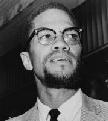 Malcolm X Malcolm X |
| |
| | Biographical fast facts | |
Full or original name at birth: Malcolm Little
Date, time and place of birth: May 19, 1925,
at 10:25 p.m., University Hospital, Omaha, Nebraska, U.S.A. *
Date, time, place and cause of death: February 21, 1965,
at 3:10 p.m.**, at the Audubon Ballroom, 166th Street
and Broadway, New York City, New York (Assassinated - Gunshots)
Marriage
Wife: Betty Jean Sanders (later, Betty X, then Betty Shabazz)
(m. January 14th, 1958 - February 21st, 1965) (his death)
Wedding took place in Lansing, Michigan.
Children
Daughters: Attallah (b. November 16, 1958)
Qubilah (b. December 25, 1960)
Ilyasah (b. July 22, 1962)
Gamilah Lumumbah (b. December 4, 1964)
Malikah Saban Shabazz and Malaak Saban Shabazz (twins b. September 1965)
Parents
Father: Earl Little (b. 1890 - d. September 28, 1931)
Mother: Louise Langdon Norton Little (1897-1991)
Burial site: Ferncliff Cemetery, Hartsdale, New York, U.S.A.
| |
| | Error corrections or clarifications | |
* Many sources mistakenly report his
boyhood home at 3448 Pinkney Street (now
34th and Evans Street), Omaha, Nebraska,
was his birthplace. Although he certainly did
live at that address with his family for a
short time, his birth certificate clearly
shows he was not born there. Malcolm
himself confirms this fact, in The
Autobiography of Malcolm X.
** Following his assassination at 3:10 p.m. at
the Audubon Ballroom, he was rushed to
Vanderbilt Clinic, at Columbia Presbyterian
Hospital, where he was dead on arrival. All
attempts to resuscitate him failed and he
was "officially" pronounced dead at 3:30 p.m.
As a result, some sources report 3:30 p.m.
as his time of death, but hospital records
clearly show he was dead on arrival, and
"did not respond at all to resuscitative
measures."
| |
| | Career | |
Working with Elijah Muhammad and the Nation of Islam,
he became an influential militant African-American
leader who articulated the concept that the white man
was evil, and the best course for black people was to
separate themselves from Western, white civilization --
culturally, physically and politically.
On a pilgrimage to Mecca, the Islamic holy city in
Saudi Arabia and birthplace of the Muslim prophet
Muhammad, he experienced a significant conversion.
The many white people he met during his 1964 pilgrimage
displayed a spirit of unity and brotherhood that provided
him with a new, positive insight into race relations.
He modified his views of black separatism, no longer
believed that all white people were evil, and felt
he'd found the true meaning of the Islamic religion.
Malcolm now believed that Islam provided the power to
overcome racial antagonism for people of all races
and nationalities. Following his conversion, he took
the name El-Hajj Malik El-Shabazz and vowed to promote
greater harmony among all blacks, including non-Muslims,
as well as white civil rights activists he had previously
alienated with his uncompromising positions. His newfound
beliefs caused tensions to mount with the Nation of Islam,
Louis Farrakhan, and Elijah Muhammad. Amidst growing
hostility, he broke from the Nation of Islam and founded
his own Muslim associations, Muslim Mosque, Inc. and the
Organization of Afro-American Unity. Rather than easing
tensions, this only served to exacerbate the situation,
and led to violence and threats against his life.
His assassination at the hands of rival Black Muslims
with ties to the Nation of Islam, focused more attention
than ever on his teachings. There is a long-held suspicion
that Louis Farrakhan, later to be the leader of the Nation
of Islam, was behind his assassination. The publication
of Malcolm's autobiography in 1965, made him an ideological
hero to many young African-Americans. A perennial best-seller,
The Autobiography of Malcolm X has allowed successive
generations to learn of his transformation and hear his
powerful message of tolerance and compassion.
| |
| | Sources | |
The most in-depth of more three dozen
sources consulted in preparing this
profile:
The Autobiography of Malcolm X (1964)
Malcolm X: By Any Means Necessary, by Walter Dean Myers (1993)
| |
| |
If you find the above data useful, please
link to this page from your webpage, blog or
website. You can also help support
Internet Accuracy Project's work by contributing
surplus office supplies, or used books.
Alternatively, consider recommending us to
your friends and colleagues. Thank you in
advance! | |
Copyright © 2005-2012 INTERNET ACCURACY PROJECT. All rights reserved. All
content, is the exclusive property of Internet Accuracy Project
and may not be reproduced (on the Web, in print, or otherwise)
without the express written permission of our organization.
BY ACCESSING THIS SITE YOU ARE STATING THAT YOU AGREE TO
BE BOUND BY OUR TERMS AND CONDITIONS
regardless of whether you reside in the United States of
America or not. Our Privacy Policy.
This page was last updated January 1, 2012.
| |
| |
