|
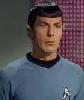
Leonard Nimoy grew up in a Jewish Orthodox
neighborhood in Boston, went to an Orthodox
synagogue, and sang in the choir. His family
actually spoke Yiddish at home. He began
acting on stage as a child in Boston, and
as a teen, he performed at war bond rallies.
His older brother, Melvin Nimoy, graduated
from MIT and became a chemical engineer.
Leonard studied drama at Boston College and
later the Pasadena Playhouse (1949-50)
before finding small parts in B-movies and
TV shows. A brief stint of military service
(December 3rd, 1953 - November 23rd, 1955)
interrupted his early years as a young
character actor.
Even after numerous television guest
appearances, he was unknown to the public
until Gene Roddenberry cast him in the
role of a lifetime. As the half-human,
half-Vulcan science officer on the
USS Enterprise, Spock became one of the
most popular characters on the show.
Viewers were particularly intrigued by
his struggle to remain logical and
emotionless. Nimoy earned three Emmy
nominations** for his work on the series,
one for every year Star Trek aired. Following
its cancellation, the show developed a
massive cult following when it was rerun
in syndication. In 1973, this led to
an animated cartoon series, Star Trek (a.k.a.
Star Trek: The Animated Series), for which
the original Star Trek actors provided
the voices. George Takei who portrayed Sulu, and
Nichelle Nichols who played communications
officer Uhura, were not originally asked
to reprise their Star Trek characters
for the animated series. Takei recalled,
"When they first got the project together,
Nichelle and I were not asked to participate.
When Leonard learned of that, he said to
the producers, 'Then you're not interested
in having me, because one of the key pillars
of Star Trek is diversity and people of
different cultures working together.' Leonard
used his clout, because they absolutely needed
Leonard, and we were called in to do our
voices on the series. This just shows how
Leonard is truly a human being with great
integrity."
After the cancellation of Star Trek (1966-69),
Nimoy joined the cast of Mission: Impossible
as a series regular, where he played Paris, a
master of disguise (1969-1971). Then, from
1976-82 (144 episodes) he served as host and
narrator of the syndicated television show
In Search of ... The documentary series
investigated paranormal, and unexplained events.
Many are unaware of the fact Leonard Nimoy
had a noteworthy career as a director. In
addition to directing Star Trek III: The Search for Spock
(1984), and Star Trek IV: The Voyage Home (1986),
he was responsible for the entertaining smash
hit Three Men and a Baby (1987), as well as
The Good Mother (1988), Funny About Love (1990),
and Holy Matrimony (1994). He also directed
his former Star Trek co-star, William
Shatner, on his '80s series T.J. Hooker.
He'd made his directorial debut back in the early
1970s on Rod Serling's Night Gallery.
In addition to his acting, Nimoy is an
accomplished photographer who has had
exhibitions of his works, is a published
poet, and a singer whose early albums are
known more for their camp value than any
exceeding vocal aptitude. He's been married
twice, and has two children from his first
marriage. His son Adam is an accomplished
director with numerous television credits.
His son actually directed him in the
I, Robot episode of The Outer Limits
TV series in the 1990s, which was a remake
of the original I, Robot episode in the
original The Outer Limits show back in
the 1960s. Leonard Nimoy starred in that
original episode as well.
His vocal stylings can be heard on his albums
Leonard Nimoy Presents Mr. Spock's Music from Outer Space,
Two Sides of Leonard Nimoy, The Way I Feel, The Touch
of Leonard Nimoy and The New World of Leonard Nimoy.
Volumes of his poetry (some of which were
self-illustrated with his photographs)
include You and I (1973), Will I Think of You
(1974), We Are All Children Searching for Love:
A Collection of Poems and Photographs (1977),
Come Be with Me (1978), These Words Are for You (1981),
and Warmed by Love (1983).
He wrote two autobiographies, the first,
I Am Not Spock, published in 1975, and
the second, I Am Spock, published in 1995.
In 2002, Nimoy announced he was retiring from
acting so he could focus on his photography.
Following his initial retirement, he and his
wife made sizable donations to the Museum of
Contemporary Art in Los Angeles to endow the
Nimoy Fund for Emerging Artists, and another
to the Griffith Observatory in Los Angeles
for its renovation. The Griffith Observatory
officially reopened its doors to the public
November 3rd, 2006, after completing a four-year
$93 million renovation and expansion project.
The observatory's 200-seat Leonard Nimoy Event
Horizon Theater was so named following a
million dollar donation made by Nimoy and
his wife, in 2001.
The Nimoy Foundation works to fund organizations
that support visual artists through direct
fees and/or subsidies of space, supplies
and services; to connect artists with
institutions that can advance their careers;
to support artists working in communities
who have a goal of mentoring and teaching
others, especially young and aspiring artists;
and to inspire other philanthropists to
support the arts. At the time of The Nimoy
Foundation's 2007 grant announcements, Leonard
Nimoy said, "We are delighted our program
has funded hundreds of artists working in
top visual arts centers. To support the
highest level of artistic vision, creativity
and free expression is most satisfying.
Finally, knowing our investment has inspired
other philanthropists to fund the arts--and
the work of artists--is indeed rewarding."
Published in 2007, The Full Body Project:
Photographs by Leonard Nimoy, raised more than
a few eyebrows with his nude photographs
of obese women. Another book showing his
talents behind the lens, was Shekhina, published
in 2002.
Nimoy was occasionally lured out of retirement
for an acting role. He appeared in J.J. Abrams'
2009 film Star Trek, and had the recurring
role of William Bell on TV's supernatural series
Fringe. "I answer the phone, particularly
when J.J. Abrams calls me," the actor noted in 2010.
Selected film credits:
Leonard's Star Trek feature film credits include
Star Trek: The Motion Picture (1979), Star Trek II:
The Wrath of Khan (1982), Star Trek III: The Search for Spock
(1984), Star Trek IV: The Voyage Home (1986), Star Trek V:
The Final Frontier (1989), Star Trek VI: The Undiscovered
Country (1991), Star Trek (2009), and
Transformers: Dark of the Moon (2011). Other motion picture
credits include the Western Catlow starring Yul Brynner
and Richard Crenna (1971), and the first-rate 1978 remake
of Invasion of the Body Snatchers with Donald Sutherland.
Another of his notable roles was in a 1991
TV-movie for which he also served as executive
producer. Never Forget told the story
of Holocaust survivor Mel Mermelstein who
successfully sued the Institute for Historical
Review, which claimed the Holocaust never
happened.
Selected TV guest appearances:
Nimoy also guest starred on many notable television series
such as Highway Patrol, 26 Men, Dragnet,
Colt .45, Rawhide, M Squad, Sea Hunt,
The Rebel, Bonanza, Wagon Train, Tales of Wells Fargo,
The Twilight Zone, Laramie, The Untouchables,
Perry Mason, Dr. Kildare, The Outer Limits,
The Man from U.N.C.L.E., Death Valley Days,
Kraft Suspense Theatre, The Virginian, Combat!,
A Man Called Shenandoah, Daniel Boone, Get Smart,
Gunsmoke, Rowan & Martin's Laugh-In, The Hollywood Palace,
The Flip Wilson Show, The Mike Douglas Show,
Night Gallery, Columbo, T.J. Hooker,
Star Trek: The Next Generation, Shelley Duvall's Faerie Tale Theatre,
The Simpsons, Futurama, Becker, and Fringe.
Selected stage credits:
He appeared in several Broadway productions,
and gave many acclaimed performances on stage.
His theater credits include, Full Circle, Equus,
My Fair Lady, Fiddler on the Roof, Camelot,
Sherlock Holmes, The King and I, A Streetcar Named Desire,
One Flew Over the Cuckoo's Nest, Oliver, Love Letters,
and Vincent. Vincent was a touring one-man
drama Nimoy wrote himself, and starred in, as
Theo van Gogh, brother of the artist Vincent van Gogh.
|