| |
| President Dwight D. Eisenhower |
|
Dwight D. Eisenhower was the 34th President
of the United States (1953-61), President
of Columbia University (1948-53), U.S. Army
chief of staff (1945-48), Supreme Commander
of World War II European Allied Forces
(1943-45), and a five star U.S. General.
Following a distinguished military career,
he served two terms as U.S. President. He
is credited with bringing the Korean War
to an end and ushering in a lengthy period
of economic growth, low inflation, low taxes,
peace and prosperity.
|
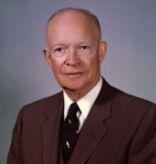 Dwight D. Eisenhower Dwight D. Eisenhower |
| |
| | Biographical fast facts | |
Full or original name at birth: David Dwight Eisenhower *
Nickname: Ike
Date, time and place of birth: October 14, 1890,
at 5:19 p.m., at the corner of Lamar Avenue and Day Street, Denison, Texas, U.S.A.
Date, time, place and cause of death: March 28, 1969,
at 12:35 p.m., Walter Reed Medical Center, Washington D.C. (Heart failure)
Marriage
Spouse: Mamie Geneva Doud (m. July 1, 1916 - March 28, 1969) (his death)
Wedding took place at 12 noon, in the first-floor
music room of the Doud family home at 750 Lafayette Street,
Denver, Colorado, U.S.A. **
Children
Sons: Doud Dwight "Icky" Eisenhower (b. September 24, 1917,
Denver, Colorado - d. January 2, 1921, Camp Meade,
Maryland, of scarlet fever)
John Sheldon Doud Eisenhower (b. August 3, 1922,
Denver, Colorado - present)
Family/Relatives
Siblings: Arthur Bradford Eisenhower (b. November 11, 1886, Hope, Dickinson
County, Kansas - d. January 26, 1958, Kansas City, Missouri)
Edgar Newton Eisenhower (b. January 19, 1889, Hope, Dickinson County,
Kansas - d. July 12, 1971, Tacoma, Washington)
Roy Jacob Eisenhower (b. August 9, 1892, Abilene, Dickinson County,
Kansas - d. June 17, 1942, Junction City, Geary County, Kansas)
Paul Eisenhower (b. May 12, 1894, Abilene, Dickinson County, Kansas -
d. March 16, 1895, Abilene, Dickinson County, Kansas, of diphtheria)
Earl Dewey Eisenhower (b. February 1, 1898, Abilene, Dickinson County,
Kansas - d. December 18, 1968, Scottsdale, Arizona)
Milton Stover Eisenhower (b. September 15, 1899, Abilene, Dickinson
County, Kansas - d. May 2, 1985, Baltimore, Maryland***) (brothers)
Parents
Father: David Jacob Eisenhower (b. September 23, 1863,
Elizabethville, Dauphin County, Pennsylvania -
d. March 10, 1942, Hope, Dickinson County, Kansas)
(a mechanic/railroad worker/shopkeeper/gas company manager)
Mother: Ida Elizabeth (Stover) Eisenhower (b. May 1, 1862, Mount Sidney,
Virginia - d. September 11, 1946, Abilene, Dickinson County, Kansas)
Burial site: Place of Meditation, Eisenhower Library, Abilene, Kansas, U.S.A.
| |
| | Error corrections or clarifications | |
* President Eisenhower was born David Dwight Eisenhower,
not Dwight David Eisenhower as some sources report.
His family had always addressed him by his middle name
(Dwight) to differentiate him from his father, who was
also named David, and later came to be known as Dwight
David Eisenhower. Birth records, the Eisenhower family bible,
and the Eisenhower's themselves, all confirm he was born
David Dwight Eisenhower, and later transposed his first
and middle names.
** A newspaper marriage announcement reversed the
last two digits of the Doud family's home address,
erroneously reporting Lieutenant Eisenhower married Mamie
at "705 Lafayette" in Denver, instead of the correct
address of 750 Lafayette Street, Denver, Colorado, U.S.A.
*** A couple of sources have confused Earl Dewey Eisenhower's
year and place of death with both Milton Eisenhower
and John Sheldon Doud Eisenhower. Consequently,
you may find both John and Milton erroneously listed
as having died in 1968, when, in point of fact, they
both lived many years beyond that.
One final clarification:
Doud Dwight Eisenhower's nickname was originally "Little Ike"
but it was changed within a few days of his birth to "Ikey"
then changed again to "Ikky" and was spelled that way
throughout his short life. Years later, "Icky" became the
preferred spelling, and even former President Eisenhower
began offering that spelling in his memoirs.
| |
| | Biography - Selected writing credits - Hobbies | |
David Dwight Eisenhower (later changed to Dwight David
Eisenhower) was the third of seven sons. In his book
The White House Years, Volume I: Mandate for Change,
1953-56, Ike described his childhood: "The life we
had together - my father, mother, brothers and I had
been complete, stimulating, and informative, with
opportunity available to us for the asking. We had
been poor, but one of the glories of America, at the
time, was that we didn't know it. It was a good, secure,
small-town life, and that we wanted for luxuries
didn't occur to any of us."
The future 34th President of the United States graduated
from Abilene High School in 1909. In 1911 he obtained an
appointment to the West Point Military Academy, graduating
June 12th, 1915. He was commissioned a second lieutenant
and assigned to the 19th Infantry, San Antonio, Texas.
It was there in October 1915, that he met his future wife.
Dwight D. Eisenhower's courtship of young Mamie was brief.
They were formally engaged Valentine's Day 1916. The couple
had originally planned a November wedding, but circumstances
forced them to move the date up several months. At 12 noon
on July 1st, 1916, they were wed in the first-floor music
room of the Doud family home at 750 Lafayette Street, Denver,
Colorado. The ceremony was performed by the Reverend William
Williamson, visiting from Leicester, England.
The newlyweds set up housekeeping in Ike's bachelor quarters
at Fort Sam Houston. Mrs. Eisenhower, who had been raised
in prosperous surroundings, admitted that it was actually
Ike who taught her to cook. It would be the first of more
than thirty homes they would share, as necessitated by his
military and political career. She often moved with Ike to
various Army posts around the world as he quickly worked his
way up in the ranks. Conditions during the early years were
sometimes less than ideal. One good example was their "home"
in the Panama Canal Zone, which leaked during the frequent
rains, and was infested with bats.
They had two sons, Doud Dwight Eisenhower, born September
24th, 1917, and John Sheldon Doud Eisenhower, born August
3rd, 1922. Tragically, their first son died of scarlet
fever at the age of three. His death remained an open
wound from which the couple would never fully recover.
His distinguished military career included assignments
such as assistant executive to the assistant Secretary
of War (1929-33), assistant to General Douglas MacArthur
(1935-39), and supreme commander of European Allied Forces
(1943-45). Following the defeat of Nazi Germany in 1945,
Eisenhower became one of the most decorated military men
in history. Not only were numerous prestigious honors
bestowed upon him by the United States, but grateful
nations around the world lined up to confer their highest
honors on him.
General Dwight D. Eisenhower next served as U.S. Army
chief of staff (1945-48), and President of Columbia
University (1948-53). December 19th, 1950, he was
granted a leave of absence from Columbia University
to serve as commander of North Atlantic Treaty
Organization (NATO) forces in Europe. May 31st, 1952
he retired from active service, and in July of '52,
resigned from the Army to run for President.
Ending the war in Korea was one of his principal
campaign promises. After his victory over Democratic
challenger Adlai Stevenson, he set about
fulfilling that promise. Ike laid the groundwork
for ending the war, before he'd even taken office.
In July of 1953, just months after his inauguration,
he delivered on his campaign pledge, bringing the
Korean War to an end.
Despite suffering a heart attack September 24th,
1955, President Eisenhower was easily reelected
in 1956. While serving his second term in office,
he suffered a stroke (November 25th, 1957), but
made a quick recovery. Under his leadership, the
United States experienced an extended period of
economic growth, low inflation, low taxes, peace
and prosperity. Both in his military and political
career, Eisenhower was known as a superb administrator.
He was a natural leader with an exceptional ability
to organize, delegate authority, and mediate.
Eisenhower was responsible for signing legislation
authorizing funding for the modernization and
integration of American roads into a national
interstate highway system. It was a massive public
works program that ranked amongst the largest in
U.S. history.
September 11th, 1956, President Eisenhower founded
People to People International to promote "international
understanding and friendship through educational,
cultural and humanitarian activities involving the
exchange of ideas and experiences directly among
peoples of different countries and diverse cultures.
People to People International is dedicated to enhancing
cross-cultural communication within each community, and
across communities and nations. Tolerance and mutual
understanding are central themes. While not a partisan
or political institution, PTPI supports the basic values
and goals of its founder, President Dwight D. Eisenhower."
The organization is also known for its presentation of
the prestigious Eisenhower Medallion. The Eisenhower
Medallion is presented to an internationally known
individual or organization in recognition of their
exceptional contribution to world peace and understanding.
Following two terms in the White House, the former
President retired to his Gettysburg farm. Mamie had
overseen the major reconstruction of the home, and
they were finally able to actually enjoy some quiet
time alone. They traveled extensively, Ike was able
to really enjoy his golf, and they were both doting
grandparents. While golfing February 6th, 1968, in
Palm Springs, California, 77-year-old former President
Eisenhower achieved every golfer's dream. He scored
a hole-in-one on the par 3, thirteenth hole at the
Seven Lakes Country Club. Ike's health worsened as
the 1960s progressed. He died March 28th, 1969, and
Mamie died ten years later, November 1st, 1979.
Businessman Albert Pick, Jr. said of him:
"Mr. Eisenhower lived life to its fullest and left behind
him an enviable record of greatness. He was a man of courage,
a man of the highest integrity, a religious man, and a man
of peace--truly a man of all seasons."
Selected writing credits:
Crusade in Europe (1948)
Peace with Justice: Selected Addresses (1961)
The White House Years, Volume I: Mandate for Change, 1953-56 (1963)
The White House Years, Volume II: Waging Peace, 1956-61 (1965)
At Ease: Stories I Tell to Friends (1967)
In Review, Pictures I've Kept: A Concise Pictorial "Autobiography" (1969)
Hobbies/sidelines:
Golf, oil painting, fishing, hunting, skeet shooting,
cooking, and in his youth, football.
Eisenhower took up painting late in life, and actually became
quite skilled. He had a long-term correspondence with British
Prime Minister Winston Churchill who also enjoyed painting. One
of Ike's most famous paintings was of Churchill, which demonstrated
he'd become quite an accomplished artist in a very short time.
| |
| | Sources | |
The most in-depth of more than four dozen
sources consulted in preparing this
profile:
Crusade in Europe, by Dwight D. Eisenhower (1948)
In Review, Pictures I've Kept, by Dwight D. Eisenhower (1969)
Mrs. Ike: Portrait of a Marriage, by Susan Eisenhower (2002)
Dwight D. Eisenhower: Soldier, President, Statesman, edited by Joann P. Krieg (1987)
Eisenhower: A Centennial Life, by Michael R. Beschloss (1990)
Eisenhower, by Stephen E. Ambrose (1990)
Dwight D. Eisenhower: A Man Called Ike, by Jean Darby (1989)
Ike and Mamie: The Story of the General and His Lady, by Lester and Irene David.
| |
| |
If you find the above data useful, please
link to this page from your webpage, blog or
website.
Alternatively, consider recommending us to
your friends and colleagues. Thank you in
advance! | |
Copyright © 2005-2012 INTERNET ACCURACY PROJECT. All rights reserved. All
content, is the exclusive property of Internet Accuracy Project
and may not be reproduced (on the Web, in print, or otherwise)
without the express written permission of our organization.
BY ACCESSING THIS SITE YOU ARE STATING THAT YOU AGREE TO
BE BOUND BY OUR TERMS AND CONDITIONS
regardless of whether you reside in the United States of
America or not. Our Privacy Policy.
This page was last updated January 1, 2012.
| |
| |
